Friday, October 20, 2023
Most poverty is behavioral
The Left talk about poverty incessantly but their only diagnosis of it seems to be that it is because of evil men who have somehow grabbed all the wealth. So it is about time that someone gave the matter some reality-based thought.
If you are a poor Indian farmer, your big problem is definitely a lack of money. But in the Western world it is not. If you are poor in the Western world your poverty is usually a result of bad decisions.
I was born into a poor family myself so I have seen a lot of it. The poor decisions vary, from a lack of frugality -- foolish spending -- to a woman who gets her legs up for a man who will be unwilling or unable to support her through a pregnancy and child rearing. Most of the really poor are single mothers who have loaded the dice against themselves. Babies are expensive and demand a lot of time.
I once ran a boarding house in a poor area and the sort of thing I often saw was a tenant who would buy a packet of chips for a snack from a nearby service station when the same product could be had for half the price from the supermarket just a little further down the road. Such people will always be poor.
And there are of course many these days who spend big on drugs and alcohol, not to mention cigarettes and various sorts of entertainment. It's a rare person who indulges in much of those things who can save.
But saving is the key to not being needy. Even when people have a windfall of some sort -- as in a lottery win or when a rich uncle dies and leaves you a legacy, the benefited person soon returns to poverty in the absence of frugal habits.
So I think there is no doubt that most poverty these days is self-inflicted. Frugality obviously does not come easily to everyone and to some it never will.
But I do not like to be totally negative so I want to go on to setting out some ways of being frugal, in case there is someone reading this who needs encouragement in that direction.
Savings is the key to having money when you need it. So it might be helpful if I outlined some of my experiences with frugality -- spending less than you earn
I have been frugal from childhood. Frugality was preached to me at my Presbyterian Sunday school and I took to it like a duck to water. So as a kid I saved my 2/- per week pocket money rather than spending it on confectionry -- which is what most of my peers did. Though I would always buy the latest "Phantom" comics. But every now and again, my mother would borrow the money in my money box to buy family needs. How poor can you be when you have to borrow the money in your kid's money box in order to put dinner on the table? My mother's purchases were almost all from convenience stores so she just did not have a frugal mind.
So I have always lived simply and very economically, which has left me in a very comfortable situation in my old age.
The high point of my frugality came during my student days, when I lived on skim milk plus a few vitamins for around six months. I bought the skim milk from the local dairy factory in the form of a 56lb paper sack of dried skim milk, which was almost a give-away product at that time but was very nutritious all the same. So in modern terms my food bill was something like $5 per week. It was ridiculously small. As the recipient of a government scholarship to go to university I had a small living allowance and I saved virtually the whole of my allowance at that time -- and also remained in perfect health.
With my savings much reinforced, I gave that up after a while, and moved back on to a more normal but still economical diet featuring a lot of cheese sandwiches. I still like a slab of cheese on a fresh bread roll. Did you know that a dollop of plum jam on top of the cheese in your cheese sandwich really lifts it? Plum jam has always been the cheapest jam.
There are many ways you can have a good and healthy diet for a small cost -- with anything featuring eggs being high on the list. A 3-egg omelette makes a very good breakfast, with the eggs costing you a total of around one dollar only. And oats for making porridge are also very cheap. I still like a nice plate of porridge on occasions. And you can often get day-old bread for a song. It makes great toast.
These days my frugality consists of buying most of my groceries as "specials" and "markdowns" from my local supermarket. And I buy most of my alcohol in the form of Vodka, which is generally the cheapest of spirits. And if I eat out, I eat at ethnic restaurants, which often give me amazingly good dinners for a very modest price.
And I am not seized with the vice of old age: Travel. Travel can be very expensive but I did all I want of that when I was younger and highly paid.
So I now spend very little on myself and give about half of my income away to friends, relatives and conservative causes.

Monday, October 16, 2023
Pygmy elder faces eviction
This article originally appreared in the Courier Mail of August 24, 2007
IN a "heartless" move, the 105-year-old elder of Australia's "lost tribe" of Aboriginal pygmies faces eviction from her far north Queensland home.
Lizzy Woods – who relies on a wheelchair, is blind and suffers dementia – is the mother of 10 children and the oldest surviving matriarch of the Jirrbal rainforest people.
She has been classified as a "living treasure" and is the sole surviving link to the pygmy "white cockatoo" tribe – most of whom stood less than 122cm (4ft) tall – of the Misty Mountain region near Tully.
Sitting in the humble three-bedroom Ravenshoe house she has called home for nearly 25 years, she told The Courier-Mail yesterday she was angry at the impending eviction.
"They are making me homeless," said the 110cm-tall elder, surrounded by some of her five generations of offspring. "I was born in the rainforest. I grew up chasing kangaroo and picking berries off the trees. I belong here. This is my land.
"The pygmy tribe – that is my mob. And this is the place I have chosen to die."
She's 3' 6" tall. The average for the tribe was 4' or 122 cm.

Sunday, October 08, 2023
Left-wing authoritarianism: Hiding in plain sight
In 1950 a book called "The authoritarian personality" appeared. It was under the lead authorship of Theodor Adorno, a prominent European Marxist theoretician. It was immediately popular among psychologists but also had to be one of the most wrong-headed books ever written.
The very title of the book was faulty. It claimed to be about personality but everything in the book was in fact about people's attitudes. Personality tells you about what people normally DO whereas attitudes tell you about what people THINK. The distinction is important. It is not at all uncommon for people to say one thing and do another. And that was particularly so in this case.
The basic thesis of the book was that authoritarianism is uniquely conservative. And that has been the prevailing view among psychologists ever since. The vast authoritarian structures of the Soviet Union and Mao's China seem to be invisible. In a world beset by vast authoritarian regimes of the Left, there was somehow no Leftist authoritarianism!
And Leftism is intrinsically authoritarian anyway. What is a Leftist if he/she is not someone who wants to impose change on the world, whether the world likes it or not? Despite all that, Leftist psychologists often still insist that there is no such thing as Leftist authoritarianism. Something foundational to Leftism is said not to exist. The whole thing is a vivid example of Leftist reality denial.
The way out of reality used by Leftist psychologists is to look at what people SAY rather than what they DO. And there is a great discordance there. It has been known for decades that attitudes do not always reflect behaviour. People often say one thing and do another. That would seem to me to indicate the relative unimportance of attitudes. What people DO is what matters.
But if we look at Leftists of all stripes, what they DO is to attempt to impose their idea of what is a good thing onto everybody else, whether by public shaming, legislation or revolution. So Leftist expositors of authoritarianism work almost entirely with attitude statements and largely overlook what is actually happening in the world. It is only by looking at words, not deeds that they can support their claim that authoritarianism is peculiarly conservative. The many Leftist criticisms of so much in the world about them are held to show Leftists as anti-authority, while conservative acceptance of existing arrangements is said to make them pro-authority or authoritarian.
This Leftist analysis of conservatives attitudes struck me as wrong-headed as soon as I heard of it so I spent the first 20 years of my academic career (1970-1990) questioning it and endeavouring to show by survey research that is was incoherent and wrong. See http://jonjayray.com/auth.html
My work did not budge the leviathan one bit. Leftist psychologists continued on their merry way of relying on a perverse analysis of attitudes to convict conservatives of authoritarianism and exonerate themselves from it. I was wasting my time.
20 years of banging my head against a brick wall was enough, however so I ceased my survey research and attitude studies and have focused my writing ever since on looking at what Leftists DO, largely using history as my data source. See http://jonjayray.com/leftism2.html
But my studies were still focused on WHY Leftists and conservatives do different things. The explanation for what they do does not rely on attitudes so what does it rely on? And I have concluded that it does after all rely on personality, even though attitudes tell us little about personality. I have concluded that the essence of conservatism is caution and the essence of Leftism is anger. Leftists and conservatives differ in those two fundamental ways. The stance that they take on the issues of the day will vary but underlying and influencing the stance will be one of those two personality types.
So I got a rather pleasant surprise recently when some mainly Norwegian psychologists published an article questioning the non-existence of Leftist authoritarianism (Lane et al., 2023) . And they did it by the old Leftist method of analysing what people say. And one of the things that they found was that Leftist attitudes were primarily influenced by anger! They too found that anger was fundamental to Leftist authoritarianism
So even using basically Leftist methods you can -- with a lot of work -- show that Leftists are the angry people. The study concerned is a very complex one and something of a brain-breaker if you want to follow it in detail but I reproduce the abstract from it below:
The Moral Foundations of Left-Wing Authoritarianism: On the Character, Cohesion, and Clout of Tribal Equalitarian Discourse**********************************************
Left-wing authoritarianism remains far less understood than right-wing authoritarianism. We contribute to literature on the former, which typically relies on surveys, using a new social media analytic approach. We use a list of 60 terms to provide an exploratory sketch of the outlines of a political ideology "tribal equalitarianism" with origins in 19th and 20th century social philosophy. We then use analyses of the English Corpus of Google Books (n > 8 million books) and scraped unique tweets from Twitter (n = 202,582) to conduct a series of investigations to discern the extent to which this ideology is cohesive amongst the public, reveals signatures of authoritarianism and has been growing in popularity. Though exploratory, our results provide some evidence of left-wing authoritarianism in two forms: (1) a uniquely conservative signature amongst ostensible liberals using measures derived from Moral Foundations Theory and (2) a substantial prevalence of anger, relative to anxiety or sadness, in tweets analyzed for sentiment. In general, results indicate that this worldview is growing in popularity, is increasingly cohesive, and shows signatures of authoritarianism.
Wednesday, October 04, 2023

South American Military Dictators
In the late 20th century, it was a common rhetorical ploy of the more "revolutionary" Left in the "Western" world simply to ignore democracy as an alternative to Communism. Instead they would excuse the brutalities of Communism by pointing to the brutalities of the then numerous military dictatorships of Southern Europe and Latin America and pretend that such regimes were the only alternative to Communism. These regimes were led by generals who might in various ways be seen as conservative (though Peron was undisputably Leftist) so do they tell us anything about conservatism?
Historically, most of the world has been ruled by military men and their successors (Sargon II of Assyria, Alexander of Macedon, Caesar, Augustus, Constantine, Charlemagne, Frederick II of Prussia etc.) so it seems unlikely but perhaps the main point to note here is that the Hispanic dictatorships of the 20th century were very often created as a response to a perceived threat of a Communist takeover. This is particularly clear in the case of Spain, Chile and Argentina. They were an attempt to fight fire with fire. In Argentina of the 60s and 70s, for instance, Leftist "urban guerillas" were very active -- blowing up anyone they disapproved of. The nice, mild, moderate Anglo-Saxon response to such depredations would have been to endure the deaths and disruptions concerned and use police methods to trace the perpetrators and bring them to trial. Much of the world is more fiery than that, however, and the Argentine generals certainly were. They became impatient with the slow-grinding wheels of democracy and its apparent impotence in the face of the Leftist revolutionaries. They therefore seized power and instituted a reign of terror against the Leftist revolutionaries that was as bloody, arbitrary and indiscriminate as what the Leftists had inflicted. In a word, they used military methods to deal with the Leftist attackers. So the nature of these regimes was only incidentally conservative. What they were was essentially military. We have to range further than the Hispanic generals, therefore, if we are to find out what is quintessentially conservative.
It might be noted, however, that, centuries earlier, the parliamentary leaders of England -- led by Fairfax, Cromwell etc. -- did something similar to the Hispanic generals of the 20th century. Faced by an attempt on the part of the Stuart tyrant to abrogate their traditional rights, powers and liberties, they resorted to military means to overthrow the threat. There is no reason to argue that democracy cannot or must not use military means to defend itself or that Leftists or anyone else must be granted exclusive rights to the use of force and violence.
Bolivarism

It might also be noted that the Hispanic generals were operating within a very different tradition. The abiding hero of Latin America is Simon Bolivar, the great liberator. But the ideas about government put forward by Bolivar were very authoritarian -- ideas about how the masses need to be "educated" and generally dominated by a self-chosen elite -- ideas that put Bolivar in the company of men like Mussolini and Lenin -- ideas that are totally outside the democratic traditions of Anglo-Saxon conservatism. He was thoroughly Fascist once he had wrenched control from the feeble hands of the Spanish monarchy. Bolívar proclaimed himself dictator on 27 August 1828
Excerpt:
"Education was also touched upon by Simon Bolivar, especially in his Essay on Public Education, as a tool for governments to re-educate their citizens to the responsibilities and duties of participation in public life. Bolivar also commented on the weaknesses and limits of liberal democracy when writing to explain the necesity of a strong, republican form of government.... Spanish American people required that their new states be organized in such a way as to maintain order by checking the popular forces until they could be trained in the civic virtues. Bolivarism emphasizes the common good over the individual"The Hispanic generals were doing very little more than putting Bolivarism into practice and Bolivarism was certainly not conservatism.
Tuesday, October 03, 2023
(Updated from June 2013)
The extreme Right are actually the extreme Left
For the excellent reason that Right is the opposite of Left, opponents of the Left are commonly referred to as Rightist -- and that should be the end of the matter. But it is not. The problem arises from the expression "extreme right". What is "the extreme right"
The answer to that has been greatly distorted by Leftist disinformation about Hitler. Hitler was by the standards of his day a fairly mainstream socialist. Even his ideas about "Aryans" were shared by such Leftist eminences as U.S. President Woodrow Wilson, of WWI fame.
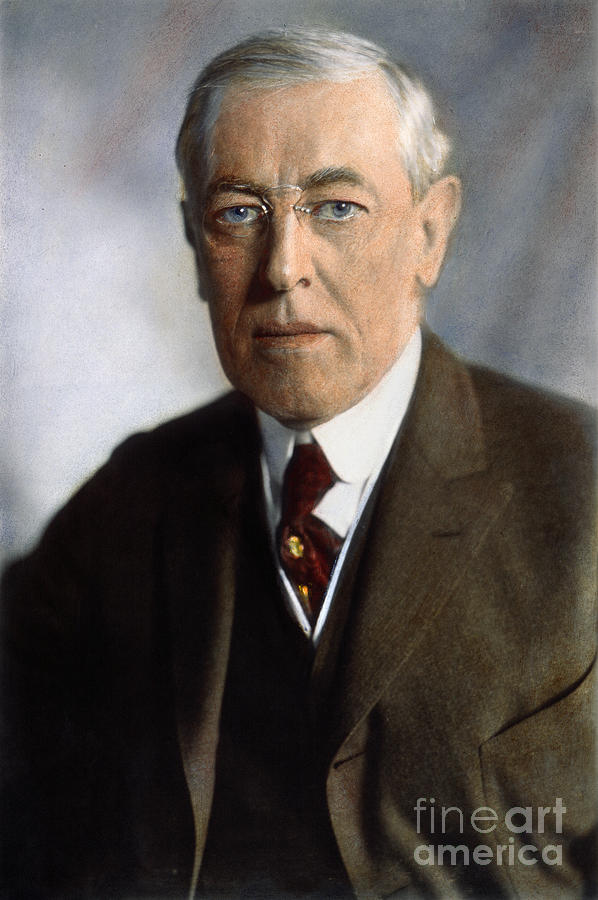
Woody
But Hitler's defeat in war created a desperate need in Leftists to deny all that. So they invariably describe him as "right-wing" to deflect attention from the fact that he was in his day one of them. He was in fact to the Right of Stalin's Communism only so the Communist view of Hitler has been conveniently adopted by the Left generally. See here for full details about Hitler's ideas and background. The name of Hitler's political party says it all: Die Nationalsozialistische Deutsche Arbeiterpartei (The national socialist German Worker's party). A socialist worker's party is "Rightist"? If you can pronounce German, you will know why that party-name was abbreviated as "Nazi"
So Leftists tend to describe all tyrants and dictators as extreme Right on the grounds that their behaviour is like Hitler's. But all the great tyrants of the 20th century -- Lenin, Stalin, Hitler, Mao, Pol Pot -- were in fact Leftists so the various postwar tyrants should logically be called "extreme Leftists" -- though that's not logic that Leftists like, of course. It's only when a tyrant or a tyranny is clearly Communist (as in, for example, Peru, Nicaragua and Nepal) that Leftists will generally desist from calling the tyrant "Right wing". It would probably be most accurate to say that most tyrants are wingless: They believe only in their own personal power
So calling conservatives Rightists does little harm when normal everyday democratic politics is concerned but once we start talking about extremes of belief a large problem arises. Conservatives reject utterly the association with Hitler that Leftists try to pin on them. It was, after all, an eminent Conservative -- Churchill -- who was the most unrelenting opponent of Hitler.
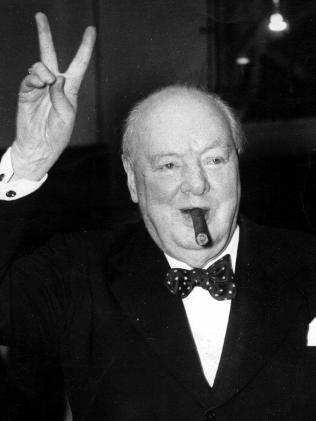
And it was a British Conservative Prime Minister -- Chamberlain -- who declared war on Hitler.
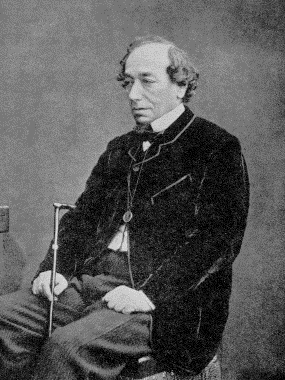
And even in the 19th century, when racism was normal, the British Conservative party made a Jew their Prime Minister, the much honoured Benjamin Disraeli. There is surely some difference between making a Jew your Prime Minister and immolating millions of them. History matters.
There is clearly a lot of variation among postwar tyrants so presumably some are better examples of what Leftists call "right-wing" than others. The Latin American dictators seem to be prime candidates but what do we make of clowns like Idi Amin or democratically elected authoritarians like Lee Kuan Yew? Exactly WHICH dictators are good examples of "Right-wing" seems to be vague. Leftists appear to have no systematic thinking on that. So some lists include Fascists like Chiang Kai Shek, the monarchs of the Muslim world and even in some cases undoubted Communists like the Kim dynasty of North Korea.
So I too will have to leave vague just who is a good example of an "extreme Rightist". For the sake of looking at the subject at all, I will use "Hitler-like" or "Fascist" as a specification of what Leftists are talking about when they say "Right wing extremist" -- and leave it at that. I have however given separate coverage of the Latin American dictators elsewhere. They have mostly been Bolivarists, a form of Fascism. And that Fascism is/was Leftist I set out at length here.
There are also of course a few individuals around in Western countries who are Hitler sentimentalists but they are so few and so unorganized that they are essentially irrelevant to modern politics. I do however have a discussion of them here.
Extremism versus stability
We are accustomed in political discussions to describe both ends of the political spectrum as "extremists". But what are the extremes? In the case of the Left it is easy: Communism. But what is an extreme conservative? The Left are sure that it is someone like Adolf Hitler but the logic of conservative commitment to individual liberty and suspicion of government makes libertarianism a much likelier extreme form of conservatism.
At this point I am going to skip forward a little, however, and say where I think people go wrong. I don't think there IS any such thing as extreme conservatism. Libertarians believe in a lot of stuff that conservatives reject. But I do believe that there is such a thing as extreme Leftism. How come?
I think that the whole polarity of politics is generally misunderstood. The contest between Left and Right is a contest between stability and irritability/anger/rage. Conservatives are the sheet anchor of society. They ensure that there is some continuity and predictability in our lives. They are the anchor that prevents us all from being blown onto the shoals of arrogant stupidity in the manner of Pol Pot and many others.
For various reasons most people in society have gripes about it. Even conservatives can usually give you a long list of things that they would wish otherwise in the world about them.
But some of the discontented are REALLY discontented -- discontented to the point of anger/rage/hate -- and among them there is a really dangerous group: Those who "know" how to fix everything.
So the political contest ranges across a spectrum from valuing stability to various degrees of revolutionary motivation.
But can there be an extreme of valuing stability? In theory yes but I have yet to hear of ANY conservative-dominated government that lacked an active legislative agenda. BOTH sides of politics have changes they want to legislate for. Conservatives don't want stability at any price any more than they want change that threatens stability. So as far as I can see, ALL conservatives want change PLUS stability. And mostly they get that.
Pulling against that anchor that keeps society going on a fairly even keel, however, there is the Left -- who want every conceivable sort of change. Some just want more social welfare legislation and some want the whole society turned upside down by violent revolution. And the latter are indeed extremists.
So there is no sharp Left/Right dividing line -- just a continuum from strong support for stability amid change to a complete disrespect and disregard for stability among extreme advocates of change.
It is possible that there is somebody somewhere in the world who values stability so much that he/she want NO change in the world about them at all. If so, I have never met such a person. Everybody has gripes and change is a constant. The only question is whether we can manage change without great disruptions to our everyday lives. Conservatives think we can and should. Leftists basically don't care about that. For them change is the goal with stability hardly considered.
Now let me skip back to a question I raised earlier. I think we are now in a better position to answer that question. The question is why do conservatives and Leftists disagree over what extreme conservatism or extreme Rightism is? And the answer is now obvious. If it does not exist, no wonder people disagree over what it is. The theoretical inference would be that an extreme conservative wants ZERO change: he/she wants stability alone. But, as I have noted, such people appear not to exist and if they do exist they are surely too few to matter.
But what about the Leftist conviction that society is riddled by people like Hitler: "Racists" and "Nazis". Leftists never cease describing those they disagree with that way. Even a moderate and compromising Christian gentleman such as George Bush Jr. was constantly accused of being a Nazi during his time in office.
Again our conception of stability versus extremism helps answer that -- particularly if you add in a dash of history. Take the "racist" allegation:
Some history
Before WWII, everybody was racist in the sense that they believed that racial differences are real and that some of those differences are more desirable than others. Both conservatives and Leftists agreed on that. And if they feel safe to say it, many conservatives still think that. I do.
But, exactly as I have pointed out above, prewar Leftists went a lot further than that. They carried their views to an extreme. They did not care how many applecarts they upset. They wanted either to breed out the inferior races (American progressives) or to exterminate them (Hitler). See here. Where conservatives just accepted a complex reality of long standing, Leftists KNEW what had to be done about it and so hurt a lot of people and did a lot of damage in the process.
When their old friend Hitler lost the war, however, Leftists had a desperate need to disavow all he stood for and so threw their whole rhetoric into reverse gear. They were still obsessed in their minds by race and racial differences but denied their previous destructive intentions towards other races. They now claimed benevolent intentions towards other races. Abandoning all interest in race was apparently beyond them. And in good Freudian style, they projected what they now disapproved of onto their opponents, conservatives. They accused conservatives of being what they still deep-down were. To see what's true of Leftists, you just have to see what they say about conservatives. They are too alienated from society to understand their fellow-man very well so they judge others by themselves
Leftist ostensible attitudes had flipped. But since conservatives had opposed Hitler and Leftism generally, conservatives for a long time just carried on with their existing moderate, balanced views. But for various reasons, what is moderate and balanced will change over time and conservative views do change to reflect that. Conservatives hold the middle ground. And while there is some change, there is also a lot of continuity in the middle ground.
For instance, a conservative today will most likely welcome Jews to his club where a conservative of the 1930s would not. But having separate clubs is hardly a major impact on civilization and the stability of society is not threatened in either case. Club membership and gassing millions are worlds apart in any objective evaluation of the matter
So in a sense Leftists are right to see that Hitler and conservatives have something in common -- some willingness to admit racial differences, for instance -- but are very wrong in their implicit claim that conservatives would carry such views to any kind of extreme. Extremes are for the Left -- not just theoretically but as a matter of historical fact. So Leftists are now as extremely anti-racist in their advocacy as they were once pro-racist. Conservatives by contrast just jog along trying to keep a firm hold on reality
So Leftists now say that what they once believed (until it became inconvenient) is "Rightist". Beat that!
Leftists take some generally accepted idea and carry it to extremes, hoping to be seen as great champions by doing so. Their extremism is a "look at me" phenomenon, a claim on especially great virtue. So whatever is conventional at the time will be something that leftists loudly champion, hoping to gain praise for doing so.
If it is eugenics that is a popular idea (as it was before the war) Leftists will energetically champion that. And they did up to WWII. Conservatives at the time also saw some sense in eugenics but did little or nothing to push it -- pointing out how eugenic policies would conflict with other values (Christian values especially) and could lead in unexpected and nasty directions.
Antisemitism is also a good example of how the Leftist decides on policy. Long before and up to WWII, antisemitism was virtually universal. Nobody liked the Jews and some degree of discrimination against them was normal and accepted. Not allowing Jews in your club was the commonest form of that.
So Leftists took antisemitism to extremes and became the leading critics of Jewry, culminating in the holocaust, which was the work of the National Socialist German Worker's Party. Leftists transformed minor discrimination into mass murder. Leftists don't present new ideas. They just push existing ones to extremes.
When Hitler lost the war, however, antisemitism suddenly had bad associations so Leftists abandoned it forthwith and became, for a while, great champions of Israel. Democrat President Truman recognized the state of Israel within minutes of its being proclaimed and the Soviet Union was only three days behind him. Popular sentiment had changed so Leftists became energetic champions of the new sentiment.
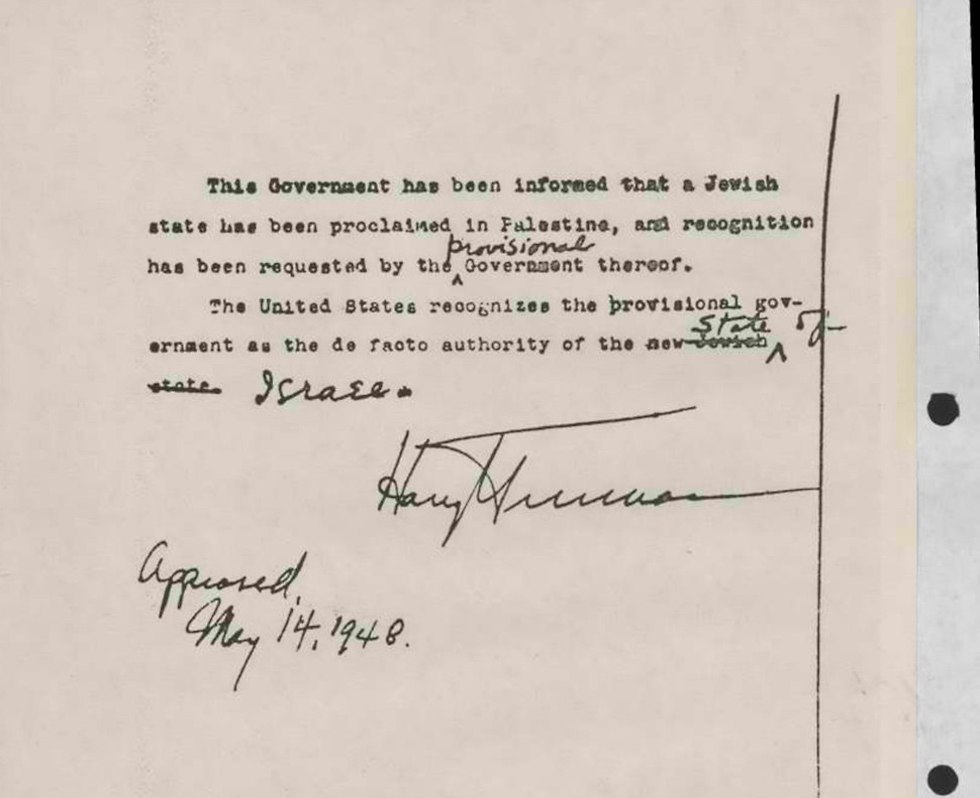
The document above signed by Truman gives a vivid contrast to what his Democrat predecessor BEFORE the war did. FDR is of course well known for sending a shipload of German Jewish refugees (aboard the MS St. Louis) back to Hitler, rather than allowing them to disembark when they arrived at Miami.
For another example of "how we were" (or how prewar Leftists were) read the following from the Old Grey Lady (NYT) herself:
"In so far as Mexican immigration is concerned, it would be idle to deny the economic usefulness of Mexican laborers. But it is essential to face the fact that the great mass of Mexican immigrants is virtually not assimilable. For the most part Indian in blood, their traditions as well as standards of living are very different from ours." [Immigrants From The New World, Jan 16, 1930]
So the default meaning of "Right" or "Rightism" here will be: "committed to stability". That is only a minimum meaning, however. There is a lot more to conservatism than that. And I present elsewhere extensive historical evidence to show what conservatism is and show continuity in how conservatism works out in practice.
Flavors of Leftism
At this stage, however, I think I should flesh out my contention above to the effect that the beliefs that would be described by the Left as extreme Right are in fact just another flavor of extreme Leftism -- perhaps a broadly old-fashioned form of Leftism but Leftism nonetheles.
Leftists would decribe that identification as patently absurd. They would say say of the "extreme Right" that "they stand for everything we are against: antisemitism, capitalism, patriotism, eugenics etc."
That is a rather amusing list but before I go on let me introduce you to the People's Action Party, long-time rulers of Singapore. At first glance, the identification of the PAP as extreme Right would seem easy. They are arguably the most pro-business party in the world. They are a shining example of the economic triumph of capitalism. And they are also very authoritaraian, with strict limits on free speech and control of even minutiae of Singapore life.
So surely the PAP is a prime example of "far Right"? Just one niggling little detail, though. They were for many years a member of the Socialist International. Their origins are on the Left and their authoritarianism is what all Leftists try for -- as is the PAP's regulation of the private sector, activist intervention in the economy, and its welfarist social policies. And its self-identification as a "People's" party is in fact characteristic of the far-Left. And for a bit of color say what the party symbol below reminds you of:

Singapore is a long way from being Nazi but it illustrates that Leftism is a house of many mansions and that support for capitalism is no bar to being Leftist. The PAP was joined in that not only by Hitler but also by 20th century Sweden. And even the U.S. Democratic party gives at least lip-service to it when in campaign mode.
The PAP even has a eugenic program. It subsidizes and otherwise supports well educated women to marry and have babies.
And then we come to antisemitism. I feel I hardly need to say anything about Leftist support for antisemitism. It goes at least as far back as Karl Marx and, under the thin disguise of "anti-Zionism" is as virulent among the modern-day Left as ever. Truman represented only a short-term blip in Leftist antisemitism. So antisemitism is certainly no bar to being Leftist.
What about patriotism? Leftist intellectuals scorn it as a weakness of simple minds so can you be a Leftist and a patriot at the same time? Again I don't think we need to go far to answer that. The U.S. Democrats claim to be patriotic and the pompous challenge, "Are you questioning my patriotism?" always seems to come from Democrat politicians. Democrat patriotism does seem to be mostly a hollow charade these days but we only have to go back to the revered JFK to find it breathing unaided: "Ask not what your country ....". And the popular patriotic song "This land is my land" was written by Woody Guthrie, a Communist. And Stalin referred to his war with Germany as "The Great Patriotic war". Yes. you clearly CAN be patriotic and Leftist.
So there is nothing incongruous at all in identifying the so-called "extreme Right" as just another flavor of Leftism. Anybody who has had much to do with the far-Left will be aware of how fractious they are and the ice pick in the head that Trotsky got courtesy of Stalin is emblematic of that. Leftists can hate one-another at least as much as they hate conservatives and the rivalry between the "far Right" and the modern-day Left is sibling rivalry -- just as it was in the days of Hitler and Stalin.
Wednesday, September 27, 2023
Blackwashing: False stories about black prominence
There is a good summary of past blackwashing episodes below:
https://pcwatch.blogspot.com/2023/02/blackwashing-just-side-issue-to.html
If you listen to some historians there have been blacks in Britain since prehistoric times. How you tell skin colour from a skeleton is unclear. But a new example of blackwashing has emerged in the form of a book called "Brilliant Black British History". It says; "the very first Britons were black” -- with not a shred of good evidence for most of the claims. Even Stonehenge was built by blacks, allegedly.The one bit of real evidence offered is that the Roman historian Tacitus reported that the Silures people in Wales were “dark-skinned and curly-haired”. In Tacitus’ full account, he theorised that they may have been from Spain.
The account by Tacitus is confirmed by Jordanes in his "Origins and Deeds of the Goths , where he says, “The Silures have swarthy features and are usually born with curly black hair ... They are like the Gauls or the Spaniards.” So both ancient authors saw the Silures as having a Mediterranean appearance, not an African appearance.
A fuller critique of the book below:
Such appropriations have been rather common from American black authors -- again as mere evidence free assertions. Blacks built the pyramids, of course. I have written on that before. See:
http://jonjayray.com/short/gyppos.html
One instance of blackwashing stands out, however: A BBC program in 2017 that describes black and mixed-race families in Britain during the Roman era. It has the distinction that a couple of British historians have defended it. A graphic from the BBC program.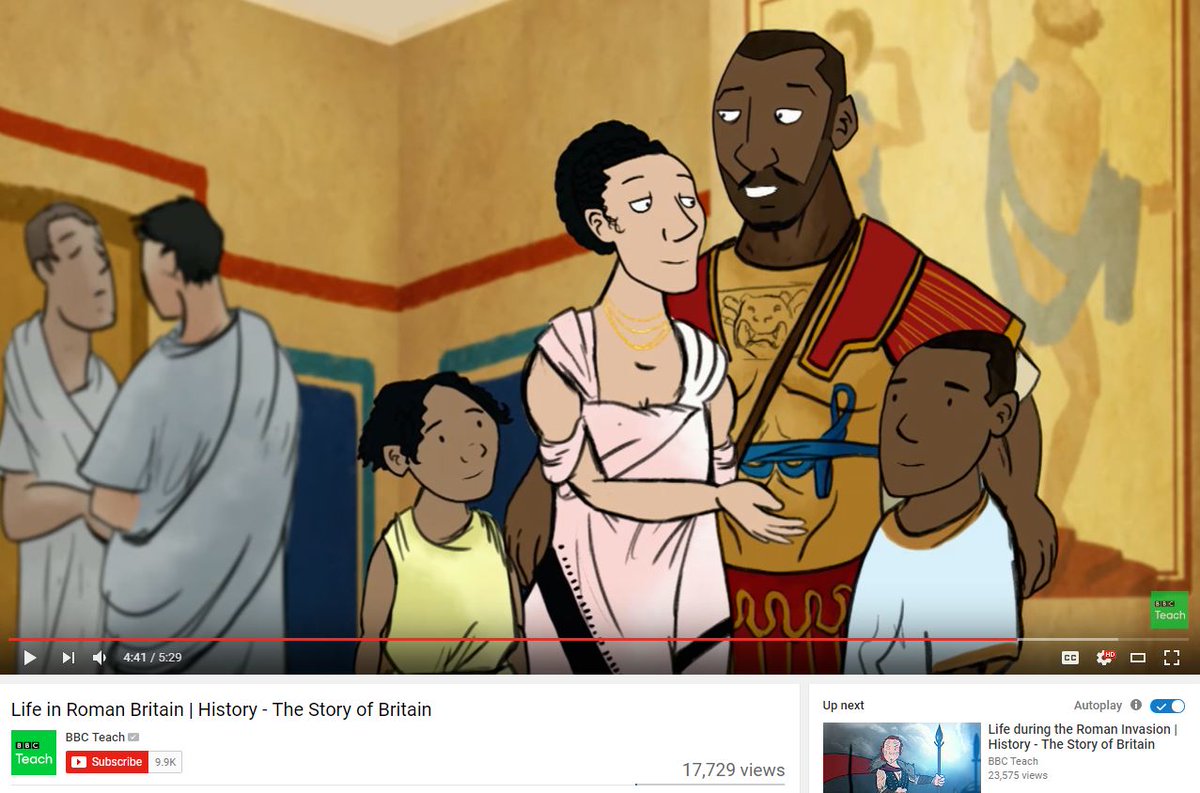
I have commented on the claims of British historian Mary Beard elsewhere so will not repeat that. Link below:
https://pcwatch.blogspot.com/2017/08/lying-old-leftist-broad-as-professional.html
A much more sustained defence of Africans in Roman Britain comes from Mike Stuchbery so I partly reproduce it below. Stuchbery's argument is mainly in a long series of tweets, which would be rather tedious to reproduce but the opening of the article concerned is as follows:Alt-right commentator gets 'schooled' by historian over diversity in Roman Britain
An alt-right commentator who complained about the BBC portraying Roman Britain as ethnically diverse has sparked a row with a historian on Twitter.
Paul Joseph Watson (PJW), editor of alt-right website InfoWars, shared a screengrab of a BBC educational video on life in Britain, suggesting it was inaccurate. “Thank God the BBC is portraying Roman Britain as ethnically diverse,” he tweeted. “I mean, who cares about historical accuracy, right?”
Step forward writer and historian Mike Stuchbery, who gave PJW a quick history lesson on ethnic diversity in Roman Britain.
“Roman Britain was ethnically diverse, almost by design. To begin, occupying legions were drawn from other parts of the Empire,” Stuchbery responded.
“Every year we dig up new remains that suggest that Roman Britain, anywhere larger than a military outpost, was an ethnically diverse place.”
https://www.telegraph.co.uk/news/2017/07/27/alt-right-commentator-gets-schooled-historian-diversity-roman/
All the examples he gives of Africans in Britain are of Mediterranean people, not sub-Saharan Africans. North Africans were and are white, of course. To this day, telling a Berber he is black will get you a dusty response. He will think you are blind or mad.

Berber woman in ethnic dress. It seems likely that the Berbers are in part descendants of the ancient Carthaginians. They are at any event the native people of most of North Africa -- JR
********************************************
Friday, September 22, 2023
Left-Right divide no longer relevant in modern politics?
A very good essay below which sets out how policy preferences change over time. The changes can indeed seem rather surprising.
What the author overlooks is that changing times require changing policies. A policy that seems right in one context may seem wrong in another. Change is always ongoing so policies have to cope with that and may need to change too
Because policies change so much, the author sees no continuity. He says a policy simply cannot reliably be described as Right or Left. There is no consistency over time in the policies of our major political groups.
He is however looking in the wrong place for consistency. Consistency can be found only at the psychological level -- at the level of basic motivations. The "Right" will always be cautious and the "Left" will always favour feelgood ideas. And those two can very easily be in conflict.
Feelgood policies are ones that make their supporter look good and kind and virtuous, regardless of what their long term-consequences may be. Because of their weak egos, Leftists in particular have a great need to be seen as supporters of such policies. Any long term ill results of the policy are simply ignored
The author gives as an example of change Donald Trump's support for import tariffs. When he did implement some tariffs, that did indeed make some conservatives' head spin. It was a major departure from something dear to the hearts of most conservatives: free trade.
But Trump's respose to free trade arrangements was a cautious one. And caution is the essence of conservatism. He was was acutely aware that by the time of his Presidency, free trade had become socially disruptive -- with vast swathes of American industry having been exported to China -- and he wanted to stop that disruption. He was cautious about how the loss of American industry was impacting the lives of many Americans and wanted to call a halt to the disruptions concerned. He felt that free trade had gone too far.
He was precisely NOT subservient to prevailing conservative policies. He saw the need to call a halt to something that had got out of hand. He saw that the prevailing circumstances in the world called for a new approach if Americans were to be looked after.
So he put forward a new policy that had very old and basic underpinnings. His cautious values had not changed, only the application of them to changing times. Trump was perfectly consistent in his love of America and its people
You’ve probably heard Donald Trump described as “right-wing” or “far-right” even. But what does this actually mean?
It turns out very little, given the former US president advocates policies that only a few years ago were considered “left-wing”, making a mockery of the idea that some timeless unidimensional spectrum informs how we should understand politics.
It’s really all just name-calling nonsense, as US politics demonstrates. Trump is in favour of higher tariffs on imports and a foreign policy anchored in isolationism, which were considered left-wing positions during the presidency of Republican George W. Bush less than two decades ago.
On the other side of the divide, President Joe Biden’s administration is in favour of empowering government agencies to censor “misinformation”, a position diametrically opposed to the anti-censorship stance of Democrats a generation or two ago.
For most of the 20th century it was “the right” in favour of political censorship.
In the US, as in Australia and throughout the world, the left-right dichotomy has become a divisive delusion, a legacy going back to who sat where in the National Assembly during the 18th-century French Revolution that has no relevance to the complexity of modern political life.
Modern political parties promote a hodgepodge of policies that bear little relationship to each other. Why, for example, should someone who supports the voice or abortion necessarily be in favour of higher taxes or using the military to “spread democracy” abroad?
What individual political leaders advocate at any given time and place determine the left and right, far more than any underlying ideology.
Lockdowns during the pandemic, for instance, became identified with left-wing politics in the US purely because Trump at one point opposed them – even though socialist governments in Mexico and Sweden roundly rejected them. “Ideologies do not define tribes, tribes define ideologies; ideology is not about what (worldviews), it is about who (groups); there is no liberalism and conservatism, but liberals and conservatives,” write Hyrum and Verlam Lewis, two American politician science academics (and brothers), in a provocative new book, The Myth of Left and Right.
We are social creatures who tend to feel strongly about one particular aspect of a political party’s platform, and then feel obliged to support the rest of it. Yet there is far more disagreement within political parties than between them.
“Why do we refer to Milton Friedman (a Jewish, pro-capitalist pacifist) and Adolf Hitler (an anti-Semitic, anti-capitalist, militarist) as right-wing when they had opposite policy views on everything?” the authors ask.
Of course, tribalism is often determined by social background and governs most political interaction. Julian Assange is widely perceived as left-wing in Australia, but right-wing in the US, simply because he infuriated the Democratic Party in the US by releasing its embarrassing private emails before the 2016 election.
Members of the two warring tribes like to tell themselves stories to justify their positions: leftists advocate for “change” and “progress”, while those on the right apparently “conserve”.
So why, then, do conservatives support capitalism, the most intrinsically revolutionary economic system ever devised?
Meanwhile, the supposedly pro-change left has for decades fought globalisation to maintain national and indigenous cultures.
The “left” is also for bigger government (except in the US for issues relating to policing and illicit drug regulation).
Why were Jimmy Carter and Bill Clinton – Democrats allegedly in favour of bigger government – the most fiscally conservative presidents in half a century? Meanwhile, Ronald Reagan, a champion of limited government, increased US debt and deficits more than any other administration outside war time.
As for religion, for much of the 19th and 20th centuries, Christian socialism was the predominant combination; the somewhat bizarre relationship between faith and free-market ideology developing much later.
Private banking, once the enemy of left-wing parties everywhere for a multitude of philosophical reasons, is now far more comfortable with parties of the left. Democrats in the US get far more donations from Wall Street, while the Labor Party has been the best friend to Australia’s funds management industry.
Italy’s “far-right” Prime Minister, Giorgia Meloni, was recently attacked by mainstream media outlets for proposing a tax on bank super profits, something Ben Chifley (one of Australia’s most left-wing leaders) would have been proud of.
Cynicism about mandatory vaccination was more common among those who considered themselves left-wing until Covid-19, when it became a “right-wing issue” across much of the West.
Left-wing China, meanwhile, was one of the few nations not to mandate Covid vaccines. Maybe Xi Jinping is right-wing?
The left-right dichotomy serves two purposes. First, it enables many of us to feel righteous and principled – even though the vast bulk of political participants are really tribal lemmings without any real beliefs except, perhaps, for personal career advancement.
Second, it provides a simplistic framework to dismiss people we don’t like. Because the bulk of those in the media and academia now consider themselves “left-wing”, one almost never sees individuals described that way. By contrast, the pool of alleged “right-wingers” has exploded.
Elon Musk, who openly supported the Democrats, is now “right-wing” because he wasn’t enthusiastic about the war in Ukraine, which is currently a “left-wing” cause. The top US podcaster, Joe Rogan, who openly supported Bernie Sanders, is now regarded as “right-wing” because he questions compulsory Covid-19 vaccination.
Germaine Greer has also been called “right-wing” for suggesting trans women aren’t real women. In a similar vein, a powerful essay by John Pilger, published last month about Western propaganda, could just as easily have been written by Tucker Carlson.
But Pilger remains firmly associated with the “left wing” because he’s in the “right” tribe, while Carlson is “right-wing” because he’s in the “wrong” tribe.
If the term “right-winger” has any meaning at all, it appears to be one that dissents from whatever official orthodoxy prevails at the time for any given policy.
Whatever, the terms are highly divisive and it’s time to move on from this meaningless division. Individuals have complex views and they should be treated on their merit.
*******************************************************
Thursday, September 21, 2023

The writer (John Ray)
29 August, 2022
My academic publications are frequently cited
I have had a lot of good news lately but "wait, there is more". According to ResearchGate, a publication which tracks such matters, my academic publications are getting a lot of attention from other academics. They say that "Your Research Interest Score is higher than 95% of ResearchGate members". The score is mainly made up of citations.
Why is that surprising? Because I last published something in the academic journals back in the '90s. The general view of academic publications is that if it is more than 10 years old it no longer exists. But the advent of the internet means that someone researching a topic will usually do an internet search at some point and that will turn up something relevant regardless of date. So as long as your writings are online they are readily accessible. Most of my publications were written before the internet existed but I have made sure to put them online retrospectively. ResearchGate has them all. Being really old means that I can look a long way back.
And the fact that I have had so many papers published (250+) of course increases the likelihood that I will hit on something of interest to others.
But I mustn't get a big head about it all. I have kept some track of my citations and they mostly come from places like Pakistan and Poland -- not great sources of cutting edge academic endeavour
Another reason for humility is that my papers that other people cite are rarely the ones which I think are most significant or important. Instead people cite papers that are more technical or utilitarian. Still, it is nice to be still ahead of the pack even after 30 years. I did after all devote 20 years of my life -- from 1970 to 1990 -- to doing all that research and writing.
I have also now spent 20 years blogging -- from 2002 to 2022.
In all my writing I have aimed to say things that are informative or helpful to others and I think I have achieved that to a small degree. I do get "thank you" messages occasionally, which I appreciate.
NOTE: There is another way in which the academic journals indicate a high level of acceptance for my academic work: My rate of publication in the journals. A look at my list of publications will reveal that in some years I was getting papers published at a rate approaching one per fortnight. That compares with the normal academic expectation of one per year
There is a subject index to my papers here
-- JR
************************************************
7 September, 2022
More on my academic status
I have just received another interesting email from ResearchGate.
They report that last week I had 6 citations. That means that someone somewhere is citing one of my papers at the rate of nearly one a day. I am rather stunned by that. And half of my reads were from academics in the USA, followed by India.
Several of my papers did refer to India so the interest from India is not too surprising
What is surprising is that my most-read article is one that appeared way back in 1971. So maybe there will be someone reading my papers long after I have gone. I like that thought
Clarification:
ResearchGate has a comprehensive database of academic publications. They are a sort of academic Google. If a paper is cited by someone already in their database they will try to add that paper also to their database. So they would appear to have just about all the academic papers on the internet. And if a paper they see cited is not already on the net they will ask for a copy of it and put it on the net
The list of "reads" is different. They refer only to reads from the ResearchGate database. Many people will of course have read the paper in its initial appearance elsewhere. So it would probably be safe to say that the total number of reads of any paper is at least twice what ResearchGate records. But the reads that they record could be seen as a useful estimate of total reads
21 September, 2022
Another update
I really am much read by my fellow academics. ResearchGate reports that my papers had 159 reads last week, including frequent mention of two that I regard as among my more significant papers. I am glad I have lived long enough to see it.
The two articles referred to are:
An "attitude to authority" scale
and
Half of All Racists Are Left Wing
It should be noted that almost all my papers are research reports rather than theoretical articles. And research reports stand as facts. You can disagree about the implications of the facts reported -- theoretical articles do that -- but you cannot disagree with the facts as such. The findings stand but what a reader does with the findings will be variable.
How much influence a reading of my papers will have is unknown. Since my findings were often uncongenial to a Leftist viewpoint they will no doubt often be read and then ignored. Leftists are good at ignoring reality
Tuesday, September 19, 2023
The Feelgood versus the rational
I have set out at some length here why Leftists tend to have ego problems. They have a great need for praise and admiration. So if an opportunity comes up for a Leftist to say or do something that will win him/her congratulations for being caring (etc.), he/she will grab that opportunity. There is nothing intrinsically wrong with that. The problem arises when the feelgood policy has consequences that are destructive or dangerous. What if some action that at first seems praiseworthy turns out to do a lot of harm if you take that action?
A Leftists will not normally be deterred by that. His/her need for praise will cause him to close his eyes to the bad consequences down the track and keep advocating anything that sounds good. He needs the praise too much to give up the feelgood policy
But conservatives are not like that. They are cautious and want to avoid doing anything that will hurt people. So they will point to the future harms of the feelgood policy and will oppose it because of those harms. The conservative does not allow the feelgood nature of some policy to swamp all other considerations.
And Australia is at the mmoment gripped by a debate over a policy that feels good to most people but which could do real harm if implemented: The "Voice" debate.
Leftist feel all warm and righteous at advocating a special voice in Federal parliament for Aborigines. Aborigines as a group are in a hell of a mess in many ways so "doing something" for them has great appeal. It shows how much heart you have for their problems and may lead to better treatment of them by future governments.
But conservatives know their history and are quite appalled by the prospect of racial privileges for one particular group. If the 20th century taught us anything, it taught us the evils of racial favoritism. There can be no doubt that racial preferences are simply evil and provoke disharmony.
So conservatives are against the Voice on that and other grounds. And that makes them the enemies of the Leftist feelgood policy. So what do the Left do when thretened with the loss of their feelgood policy? Do they simply concede the point and desist from advocating something that could be very harmful? No way. They like ther feelgood policy too much to abandon it.
So what do they do? In good Leftist style they resort to abuse and lies. They go "ad hominem". They cannot answer the conservative arguents so they impugn the motives of conservatives who oppose the polcy. In the oldest bit of Leftist abuse in the book, they accuse conservatives of racism. They say that it is racism that lies behind opposition to the "voice". That they are are the one who are advocating something racist seems quite lost on them.
So they pretend tat it is white supremacists who are their opposition while they are the good and noble guys. It's a sad commentary on the ego needs that drive such irrationality but it is a classic bit of Leftist argumentation.
The toon below describes the mythical world that the Left have created around the "Voice". One of the many things that the Left are sedulously ignoring is that it is not only white conservatives in opposition but many Aborigines too. Around half of Aborigines seem to be opposed to the Voice and say so. How come they oppose something that is supposed to help them?
The only way the Left have of dealing with that puzzle is by ignoring the Aborigines concerned. The toon features some well-known Aborigines who oppose the Voice and shows them as canvassing for a "No" vote

************************************************************
Sunday, September 17, 2023
An anachronism survives
While I am far from alone in it I appear to be one of the few still alive who had the benefit of a good classical education. That makes me an anachronism, a person from a bygone time
During my days in High school I gained a knowledge of the language and literature of three foreign languages plus ancient history and classical English literature. I entered High school at a time when a classics education was no longer compulsory but it was optionally available and I took good advantage of that opportunity
My classical education would once been have deemed incomplete without some knowedge of ancient Greek. To call a person "Greekless" was once to call them uneducated -- but to a small extent I remedied that deficiency by private study and can to this day recite two famous passages in Greek and debate the grammar involved. ἐν ἀρχῇ ἦν ὁ λόγος etc
But the point of a classical education is not to know the declension of the Latin noun "mensa" but rather what goes with classical study: The introduction to assumptions and ways of thought from different times and places. It enables us to transcend our awareness of our own times and places. It "broadens" our minds, if I may be so old-fashioned as to use that phrase. It liberates us from seeing anything in our present as being inevitable or normal. It uproots assumptions
And of the three foreign languages I studied, the one I enjoy most to this day is Latin. German and Italian are more useful to me because I also like classical music and most classical music emanates from German and Italian sources. When I hear the great Bach aria "Mache dich mein Herze rein", I actually understand what the singer is saying. And when I hear the Monteverdi madrigal "Chiome d'oro" I marvel at the fact that blonde hair was admired even in Renaissance Italy -- 400 years ago.
But Latin is the language that I enjoy most for itself. I like it in part because of its succinctness. The most famous example of that is of course "veni, vidi, vinci" but a 19th century British General in the Indian wars allegedly did even better with "peccavi". And Latin is also a powerful way of putting something. "de gustibus non disputandum est" is hard to argue with.
So the point I am making is that a classical education opens doors to both enjoyment and wisdom. To have lost it is a serious deprivation. So the fact that I write from that perspective will help keep a small amount of that perspective alive and functioning for a while.
I am aware of an appearance of inconsistency in praising the classics while it is Cemiplimab that is keeping me alive but there is no opposition between the classics and science. And as someone who has had 200+ scientific papers published in the academic journals I am an embodiment of that. I even know what heteroscedasticity refers to.
And a classical education can in fact the helpful in science. Academic writing is notoriously hard to follow but a person with a background in Latin will usually be able to write English more clearly. So an academic colleague once said to me: "John, we don't always agree with you but at least we understand what you are saying"
Subscribe to:
Posts (Atom)

 Eugenio Pacelli, a righteous Gentile, a true man of God and a brilliant Pope